
The Man Who Invented the Seat Belt and Gave It Away
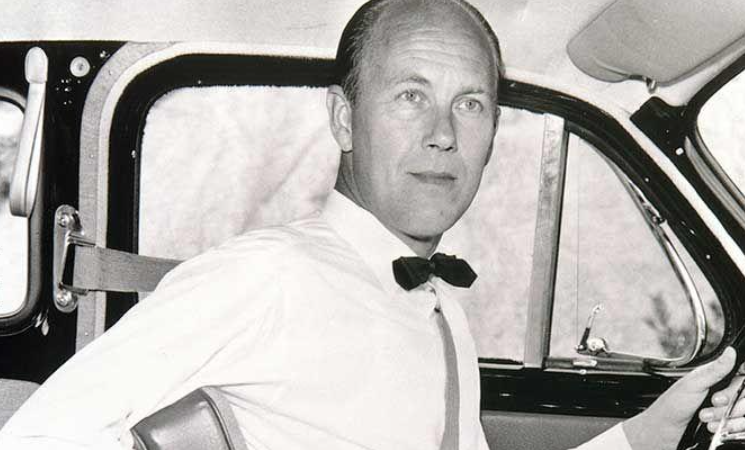
Every time you step into a car and fasten your seat belt, you are using an invention that has saved more than a million lives.
But behind that familiar click lies an extraordinary true story.
A Swedish engineer who once worked on systems designed to eject pilots from aircraft went on to create a device that would keep millions of motorists safely inside their cars.
His name was Nils Bohlin, and his invention would become one of the most important safety breakthroughs in automotive history.
What makes the story even more remarkable is what happened next.
Instead of keeping the technology exclusive, Volvo made it available to competing car manufacturers without charging them.
Before Seat Belts Became a Lifesaver
During the early decades of motoring, cars were becoming faster, more powerful and increasingly popular.
But passenger safety had not kept pace.
Many vehicles had no seat belts at all, while others used simple lap belts that restrained only the lower body.
In a serious collision, these early designs could allow the upper body to move violently forward, increasing the risk of severe injuries.
Engineers understood the problem, but finding a restraint that was both effective and comfortable proved surprisingly difficult.
Some existing systems were complicated to fasten, while others placed dangerous pressure on vulnerable parts of the body.
The automotive industry needed a better solution.
An Aircraft Engineer With an Unusual Background
Before joining Volvo, Nils Bohlin worked for Swedish aircraft manufacturer Saab, where he was involved in developing pilot ejection-seat systems.
His experience taught him something essential about sudden acceleration and the forces acting on the human body.
In an aircraft emergency, a pilot needed to be restrained securely before being propelled out of the cockpit.
In a car accident, the challenge was almost the opposite: preventing passengers from being thrown forward or ejected from the vehicle.
When Bohlin joined Volvo as a safety engineer in 1958, he brought this understanding of human movement and crash forces into automotive design.
His challenge was to create a seat belt that ordinary drivers could fasten easily while providing significantly better protection.
The Simple Idea That Changed Everything
Bohlin realised that a safer restraint needed to protect both the upper and lower body.
His solution combined a diagonal shoulder strap with a lap belt, secured at three anchoring points.
The arrangement distributed crash forces across stronger areas of the body, particularly the chest and pelvis.
Just as importantly, it could be fastened with one hand.
The result was the modern three-point seat belt.
Although earlier seat belts and multi-point restraint designs already existed, Bohlin’s practical configuration became the foundation of the system used in passenger cars worldwide.
In 1959, Volvo introduced the design as standard equipment in its PV544 and Amazon models in Nordic markets.
It was a breakthrough that would eventually transform automotive safety.
The Decision That Surprised the Automotive Industry
Volvo had patented the invention.
The company could have attempted to profit from licensing the technology to other manufacturers.
Instead, it made the design available for other automakers to use without licensing fees.
The reasoning was straightforward: a safety invention capable of protecting human lives should not be restricted to one brand.
This decision allowed the technology to spread across the automotive industry.
From small family cars to luxury sedans and SUVs, the same basic three-point restraint principle remains in use today.
Modern developments in occupant protection continue to build upon this foundation. Even vehicles equipped with sophisticated airbags and crash-protection systems still depend heavily on properly worn seat belts.
For example, the BMW X1 and BMW 2 Series Active Tourer’s crash-test performance demonstrates how modern restraint systems, airbags and vehicle structures work together to protect occupants.
At First, Not Everyone Believed in It
Surprisingly, the three-point seat belt was not immediately welcomed by everyone.
Some motorists considered seat belts uncomfortable or unnecessary, while others questioned whether they could genuinely prevent serious injuries.
Volvo continued testing and promoting the technology.
A major turning point came when the company presented its analysis of approximately 28,000 accidents involving Volvo vehicles in Sweden.
The findings showed that seat belts could substantially reduce injuries.
The evidence helped change attitudes and encouraged wider adoption throughout the automotive industry.
An Invention Credited With Saving More Than a Million Lives
The three-point seat belt has since become one of the most widely adopted automotive safety technologies in history.
Volvo estimates that the invention has saved more than one million lives worldwide.
That figure is an estimate rather than an exact count, but it illustrates the extraordinary impact of a relatively simple engineering solution.
Today’s vehicles feature intelligent cameras, automatic emergency braking, collision-warning systems and increasingly sophisticated driver-assistance technology.
Modern vehicles such as the Volvo 40 Series demonstrate how automotive safety continues to evolve through advanced electronics and digital systems.
