Unbridled, Yet Without Horses
by Fadi Takieddine
Cars replaced horses over a century ago.
But somehow… they never left.So why do modern cars still feel “unbridled”?
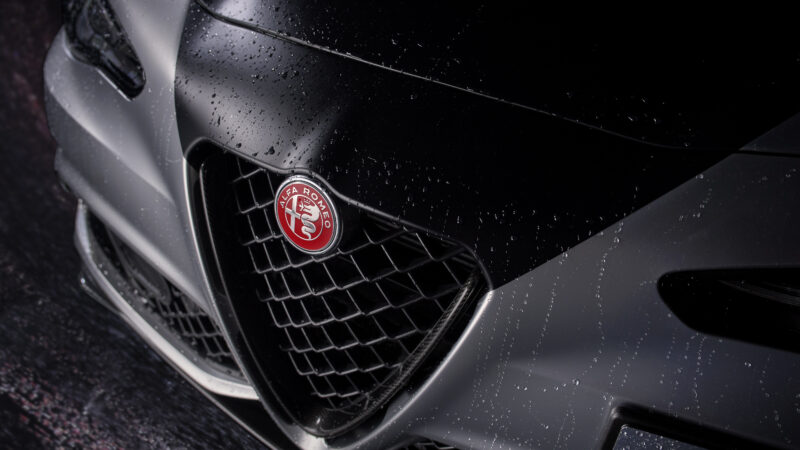
Whether it stemmed from the vision of both Enzo Ferrari and Nicola Romeo, or was just a result of long-term strategic thinking, or even a mere coincidence. The division of roles between Alfa Romeo and Ferrari has been crafted with remarkable wisdom.
The two captivating Italian marques are strikingly similar in both form and substance, to the extent that distinguishing between them often comes down only to price point or the segment in which each competes.
After all, Enzo Ferrari began his career in the world of the “four-wheeled enchantress,” overseeing Alfa Romeo’s racing activities during an era when the brand’s cars were considered elite and expensive—much like Ferrari vehicles have been since the 1950s and remain today. The key difference is that, in the post-World War II period, Alfa Romeo’s leadership chose to shift toward producing sports cars that combine stunning design with practical usability (even if the Alfas were never the benchmark for practicality) and more accessible costs—essentially defining the Alfa Romeo identity we know today.
The Alfa Romeo Giulia—a model whose need for replacement may not be immediately apparent until one realizes it has been over a decade since its debut—possesses all the qualities required to be considered an unofficial Ferrari representative in the sedan segment. It remains highly competitive in terms of performance and driving experience, as well as in its exterior design, which has retained its distinctive appeal despite the passing years.
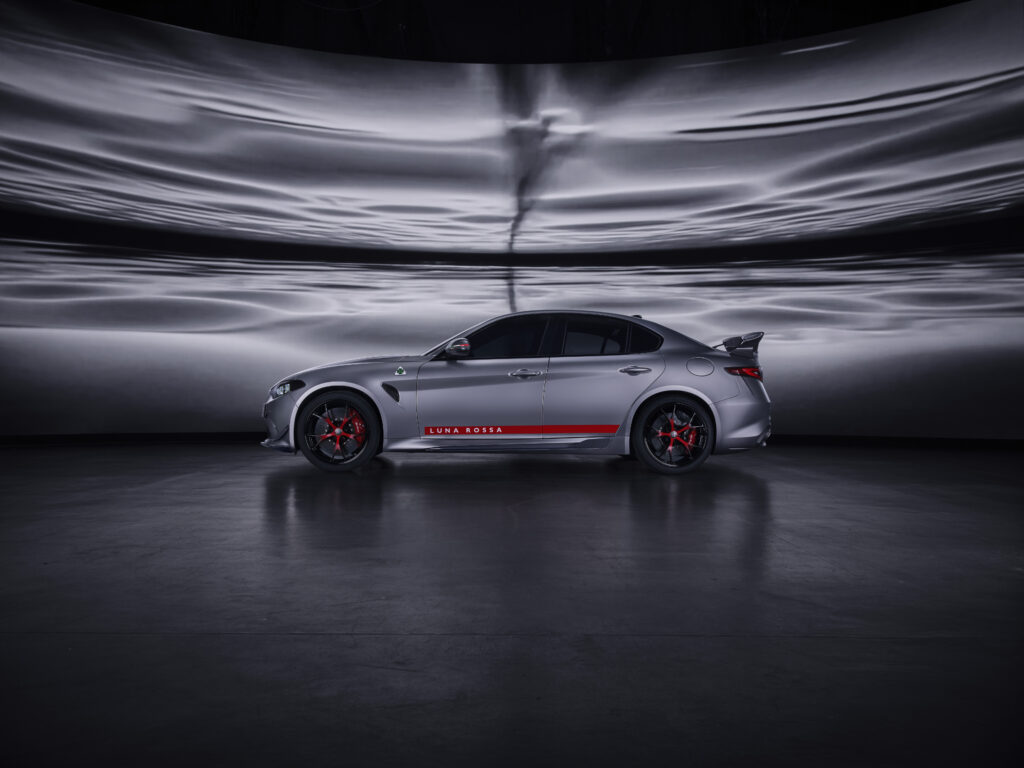
Recently, the model received a special-edition treatment called Quadrifoglio Luna Rossa, a limited-production variant developed in collaboration with an Italian sailing team competing in the America’s Cup.
Distinctive Exterior Features of the Luna Rossa
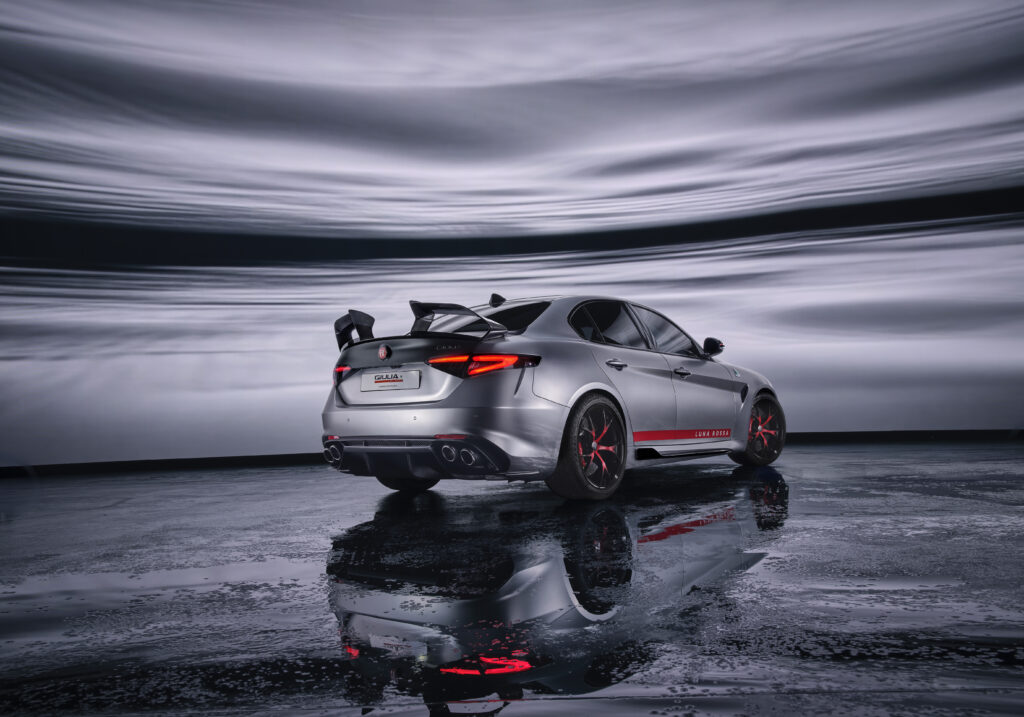
Despite its name, which suggests red, the dominant color of the Luna Rossa edition is gray, accented with red highlights across the body, along with a more effective aerodynamic package.
At the front, small winglets have been installed on the outer edges of the bumper, working in harmony with underbody fins to increase front-end downforce. Alfa Romeo has also added carbon-fiber side reflectors, along with a prominent upward fin positioned ahead of the rear wheels.
At the rear, the bold spoiler consists of two separate elements extending from the trunk lid above each taillight. This configuration enables the car to generate approximately 140 kilograms of downforce at 300 km/h—five times more than the standard model.
Mechanical Components
The engine—developed with the assistance of engineers who previously worked at Ferrari—remains sufficiently effective that no modifications are required. The 2.9-liter twin-turbocharged V6 continues to deliver 513 horsepower to the rear wheels via an eight-speed transmission.
Interior
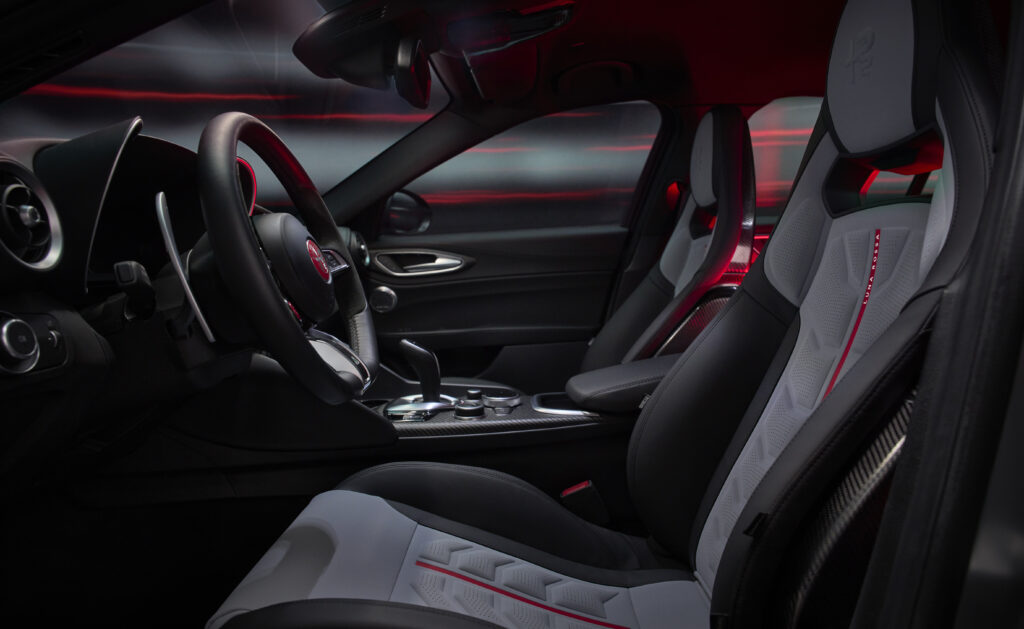
Inside, the most striking feature is the addition of red accents throughout the cabin, complementing the new gray upholstery inspired by the material used in the life jackets worn by the Luna Rossa crew.
On the dashboard, Alfa Romeo has incorporated a thin layer derived from one of the materials used to craft the sails of the renowned vessel.
The Giulia Quadrifoglio Luna Rossa is also a product of the Bottega Fuoriserie program, a recently introduced specialized division focused on bespoke vehicle design and the restoration of historic models. Only 10 units will be produced—and all have already been sold.