Lucid Announces $1.4 Billion Reset as Saudi Factory Advances
Lucid Launches $1.4 Billion Reset as Saudi Arabia Factory Moves Towards Production Trials
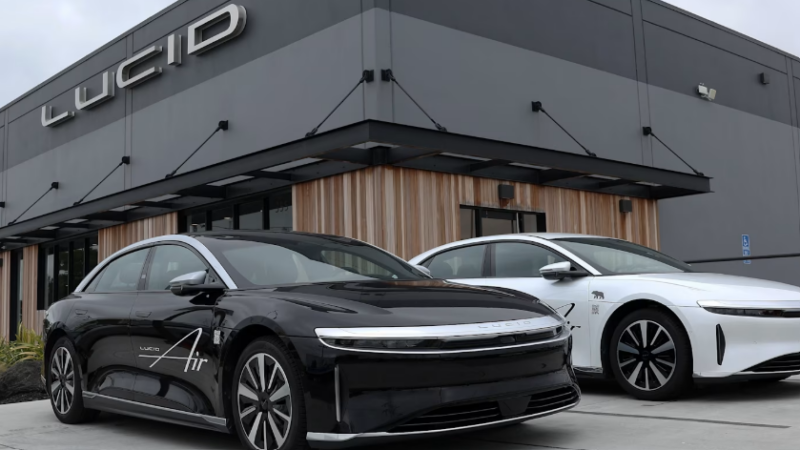
Lucid Motors has announced a major operational reset designed to reduce spending, improve execution and strengthen the customer experience as the electric-vehicle manufacturer advances several important projects, including its new manufacturing facility in Saudi Arabia.
The company revealed that it has identified approximately $1.4 billion in cash-flow improvement opportunities during 2026. The programme includes potential reductions in inventory, capital expenditure and operating expenses as Lucid concentrates its resources on what it describes as its most important strategic priorities.
Lucid’s Saudi Arabian AMP-2 manufacturing facility is central to those plans.
Saudi Arabia Factory Enters Industrialisation Phase
According to Lucid, the AMP-2 facility has moved from the construction stage into industrialisation. Manufacturing equipment for stamping, body production, painting and final assembly is being installed and commissioned in preparation for production trials.
The development represents an important milestone for Saudi Arabia’s ambition to build a domestic automotive manufacturing industry and establish itself as a major centre for electric-vehicle production in the GCC.
Lucid currently assembles vehicles at facilities in Arizona and Saudi Arabia. Expanding the capabilities of AMP-2 could eventually allow the company to manufacture more vehicle components and complete more stages of vehicle production within the Kingdom.
The company is also continuing development of its future midsize electric-vehicle platform. Prototype vehicles and Lucid’s Atlas drive units are progressing through durability testing, crash certification, battery-pack validation and cold-weather testing.
Lucid’s Second-Quarter Performance
During the second quarter of 2026, Lucid:
- Produced 4,774 vehicles.
- Delivered 3,953 vehicles.
- Generated revenue of approximately $405 million.
- Ended the quarter with around $3 billion in total liquidity.
Vehicle production increased by 24 per cent year over year, while deliveries increased by 19 per cent. Lucid said it deliberately moderated production to reduce inventory, preserve cash and align manufacturing more closely with expected demand.
The company’s proposed $1.4 billion improvement programme includes approximately $600 million to $800 million in inventory reductions, around $500 million in capital-expenditure savings and approximately $200 million in operating-expense reductions.
Robotaxi Development Remains a Priority
Lucid is also prioritising its robotaxi programme with Uber and autonomous-driving technology company Nuro.
Testing and validation are underway using a fleet of close to 100 vehicles in the San Francisco Bay Area and Houston. Lucid has begun delivering production-validation versions of the Gravity SUV to Nuro as part of the programme.
The robotaxi project will form part of Lucid Technologies, a dedicated business unit bringing together artificial intelligence, advanced driver-assistance technology, autonomous driving and digital systems.
Lucid Gravity Price and Specifications in the UAE
For UAE buyers, the Lucid Gravity is currently available to order in two versions:
Lucid Gravity Touring
- Starting price: AED 372,225
- Power: 560 hp
- Projected range: More than 500 km
- Drivetrain: All-wheel drive
Lucid Gravity Grand Touring
- Starting price: AED 435,855
- Power: 828 hp
- Projected range: More than 700 km
- Drivetrain: All-wheel drive
The Gravity can accommodate up to seven adults and offers as much as 3,415 litres of cargo capacity, depending on the seating configuration. Lucid also states that the vehicle can recover up to 320 km of driving range during approximately 15 minutes of compatible fast charging.
What This Means for the GCC Automotive Market
Lucid’s latest update is particularly significant for the Gulf region because the AMP-2 facility is one of the most prominent electric-vehicle manufacturing projects currently being developed in Saudi Arabia.
Moving from construction into industrialisation indicates that the facility is advancing towards physical production trials. However, the commissioning of equipment and successful validation of manufacturing systems will remain important before full-scale production can begin.
For GCC customers, the development could eventually support improved vehicle availability, regional servicing, parts supply and a stronger locally based electric-vehicle ecosystem.