Who Invented Car Air Conditioning?
How a Luxury Extra Became Essential for Modern Driving
Turn on a car in Dubai in the middle of summer and one feature becomes more important than almost anything else: air conditioning.
Today, drivers expect cool air within seconds. Modern cars can offer dual-zone, three-zone and even four-zone climate control, with individual temperature settings for passengers.
But there was a time when even the world’s most luxurious cars had no air conditioning at all.
So, who invented car air conditioning — and when did cars first get it?
The answer takes us back to America in the 1930s and to one of the great luxury automobile manufacturers of the era: Packard.
Explore more automotive stories in CarBook Magazine’s News section.
Before Cars Had Air Conditioning
Early motorists had very few ways to escape the heat.
Opening the windows was the obvious solution. Some cars used ventilation systems, while aftermarket accessories attempted to make hot-weather driving more comfortable.
By the 1930s, air conditioning was already beginning to transform buildings, cinemas and other indoor spaces. Engineers naturally began exploring whether refrigeration technology could also cool the interior of an automobile.
In 1933, a New York company reportedly began offering air-conditioning installations for vehicles, particularly luxury cars and limousines.
But the major automotive breakthrough was still to come.
Packard Brings Air Conditioning to the Automobile
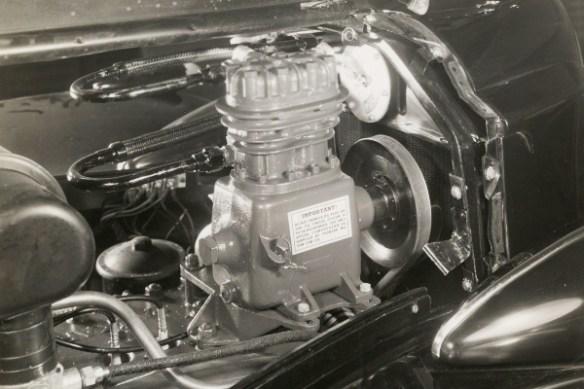
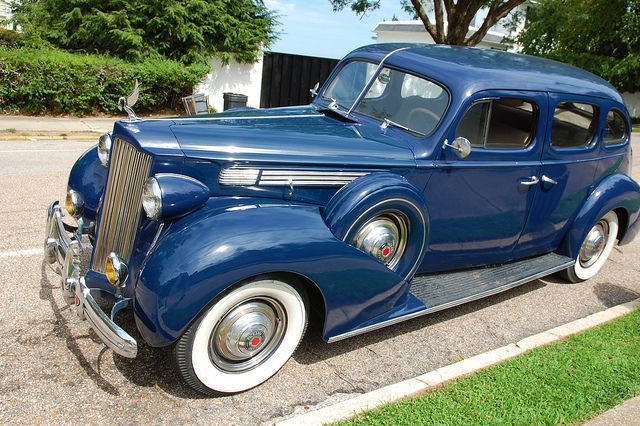
In 1939, Packard became the first automobile manufacturer to offer an optional automotive air-conditioning system for its 1940 model-year cars. The system was produced by Bishop & Babcock of Cleveland.
Packard marketed the technology as a major comfort innovation.
It was extraordinary for its time — but far from perfect.
The evaporator and blower were installed behind the rear passenger area and occupied considerable luggage space. Even more surprisingly to today’s drivers, the system lacked the convenient dashboard temperature controls we now take for granted.
Turning the cooling system completely off could even require dealing with the compressor drive belt.
In other words, the first automotive A/C was innovative, expensive and inconvenient.
But Packard had demonstrated something important: a passenger car could be mechanically refrigerated.
Read more stories about landmark automotive technology in CarBook Magazine Features.
The Breakthrough Came in 1954
The technology improved significantly after the Second World War.
Then came the 1954 Nash Ambassador.
Nash-Kelvinator combined its automotive experience with refrigeration expertise to develop the All-Weather Eye, an integrated heating, ventilation and air-conditioning system.
Unlike earlier bulky arrangements, the Nash system placed its major components at the front of the vehicle and offered dashboard controls. It was compact, more affordable and much closer to the architecture used by modern automotive climate-control systems.
This is why the Nash Ambassador occupies such an important place in automotive history.
Packard pioneered factory-offered automotive air conditioning, but Nash helped turn it into a practical integrated system.
From Luxury to Everyday Necessity
As technology improved, air conditioning spread rapidly across the automotive industry.
What had begun as an expensive luxury increasingly became an expected comfort feature.
Automatic climate control represented another major step. Instead of continually adjusting cooling manually, drivers could select a desired temperature and allow the car to regulate the cabin environment.
Today’s systems go much further.
Premium vehicles can monitor cabin temperature and sunlight intensity, offer separate climate zones and combine air conditioning with ventilated seats and sophisticated air-filtration technology.
Electric vehicles have introduced another challenge because climate control consumes energy from the same battery used for propulsion.
Explore the latest developments in CarBook Magazine’s Electric Vehicles section.
Why Car A/C Matters So Much in the GCC
Few regions demonstrate the importance of automotive air conditioning better than the UAE and wider GCC.
With summer temperatures frequently reaching extreme levels, A/C here is much more than a luxury feature. Cabin cooling is a fundamental part of everyday driving comfort.
That makes the history particularly fascinating.
A technology that began as an expensive experiment in a luxury American automobile more than eight decades ago is now something millions of GCC motorists use every day without giving its origins a second thought.
So, who invented car air conditioning?
There wasn’t one individual inventor. But Packard’s 1940 model-year system represented the landmark early manufacturer offering, while Nash’s 1954 All-Weather Eye helped establish the practical integrated system that influenced the modern automotive A/C we know today.
Discover more automotive news, technology and heritage stories at CarBook Magazine.