
The Blind Man Who Invented Cruise Control Without Ever Driving a Car
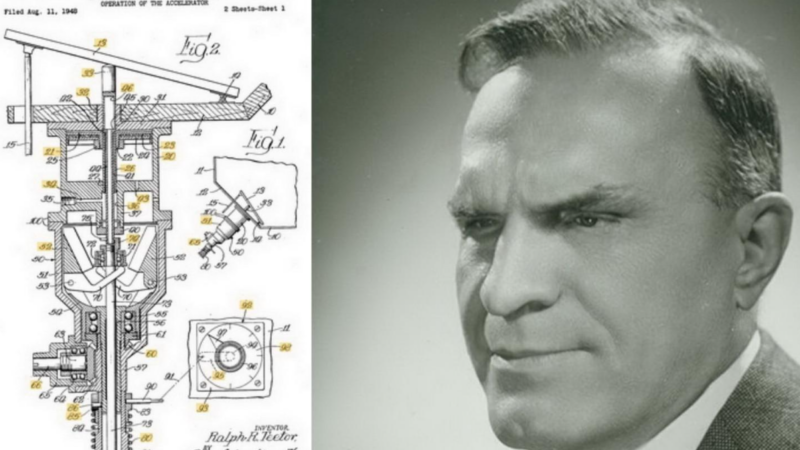
Imagine inventing a technology used by millions of drivers around the world without ever being able to drive a car yourself.
It sounds almost impossible.
Yet that is exactly what American engineer Ralph Teetor accomplished.
Despite losing his eyesight as a child, Teetor developed one of the most influential automotive technologies of the twentieth century: cruise control.
Even more surprising is what inspired the invention.
It wasn’t a major automotive research project or an expensive engineering experiment.
It was a frustrating car ride with a friend who couldn’t maintain a steady speed.
A Childhood Accident That Changed His Life
Ralph Teetor was born in Hagerstown, Indiana, in 1890.
When he was just five years old, an accident involving a knife severely injured one of his eyes. Within a year, he had lost his sight completely.
For many people at the time, blindness was considered an almost insurmountable barrier to pursuing a technical career.
But Teetor grew up surrounded by machinery.
His father and uncles operated a family manufacturing business, where he developed an early fascination with engines, mechanical components and engineering.
Rather than relying on sight, he learned to understand machinery through touch, sound and an extraordinary ability to remember how components fitted together.
By the age of twelve, he had already designed and built a small motor vehicle powered by a three-horsepower engine.
It could reach approximately 12 miles per hour.
That achievement was only the beginning.
The Engineer Who Could Understand Machines by Touch
Determined to pursue engineering, Teetor enrolled at the University of Pennsylvania.
He graduated in 1912 with a degree in mechanical engineering, becoming the first blind engineer on record in the United States.
He later joined the family business, Perfect Circle, which became an important manufacturer of automotive piston rings.
His engineering abilities earned him increasing responsibility within the company.
Colleagues were often amazed by his capacity to examine mechanical components with his hands and identify problems that others struggled to detect.
He eventually became president of Perfect Circle.
But his most famous invention began outside the factory, during an ordinary journey as a passenger.
The Annoying Car Ride That Sparked a Brilliant Idea
In 1936, Teetor was travelling in a car driven by his friend and patent attorney, Harry Lindsey.
According to accounts of the invention, Lindsey had an irritating driving habit.
Whenever he began speaking, he would slow down.
When he stopped talking to listen, he would unconsciously accelerate.
The constant changes in speed made the journey uncomfortable.
Teetor began wondering whether a mechanical device could maintain a vehicle’s speed without requiring the driver to continually adjust the accelerator.
It was a simple observation.
But the solution would eventually change the driving experience for millions of motorists.
Turning an Idea Into a Mechanical Invention
Teetor spent years developing a system capable of controlling vehicle speed.
His invention used a dashboard speed selector connected to a mechanical system that responded to the vehicle’s movement.
The early design helped the driver maintain a chosen speed by regulating accelerator operation.
In 1948, Teetor filed a patent application for his speed-control technology.
The patent was granted in 1950.
The device became known as the Speedostat.
Early versions were designed to discourage the driver from exceeding a selected speed, while later improvements introduced the ability to maintain that speed automatically.
This development marked an important step toward the driver-assistance systems found in modern automobiles.
The evolution of vehicle automation continues today through software-defined vehicles, where electronic systems and software increasingly control how cars operate.
The Invention That Chrysler Brought to the Road
Although Teetor had developed his invention years earlier, it took time for automotive manufacturers to recognise its commercial potential.
The breakthrough came in 1958.
Chrysler introduced the technology on luxury vehicles including the Imperial, New Yorker and Windsor.
The manufacturer marketed the feature under the name Auto-Pilot.
For drivers accustomed to constantly adjusting the accelerator, the technology offered a new level of convenience.
A year later, Cadillac introduced a similar system under the name Cruise Control.
That name would eventually become familiar to motorists around the world.
What began as a response to one driver’s inconsistent speed had become a commercially available automotive innovation.
How a Simple Device Evolved Into Intelligent Cruise Control
The original cruise control system was mechanical.
Its purpose was to help maintain a selected vehicle speed, particularly during longer journeys.
Over time, advances in electronics transformed the technology.
Modern adaptive cruise control systems can use radar and cameras to monitor traffic ahead.
Depending on the vehicle, these systems can automatically reduce speed when approaching slower traffic and accelerate again when conditions permit.
Some advanced systems can even bring a vehicle to a complete stop and resume movement under appropriate conditions.
However, adaptive cruise control is not the same as autonomous driving. Drivers must remain attentive and follow the limitations of their vehicle’s system.
The technology illustrates how a relatively simple mechanical idea helped lay the groundwork for more sophisticated driving assistance.
The industry’s interest in automation has also been reflected in futuristic concepts such as the Audi AI, which explores a radically different approach to personal mobility.
More Than 40 Patents and an Extraordinary Legacy
Cruise control was not Teetor’s only contribution to engineering.
Throughout his career, he received more than 40 United States patents covering different mechanical innovations.
He also became an influential figure in engineering education and served as president of the Society of Automotive Engineers.
In recognition of his contributions, SAE International established the Ralph R. Teetor Educational Award.
Teetor died in 1982.
Six years later, he was inducted into the Automotive Hall of Fame.
In 2024, he was also inducted into the National Inventors Hall of Fame.
His achievements remain remarkable not simply because he invented cruise control, but because he helped transform automotive engineering despite never experiencing driving from behind the steering wheel.
The Man Who Changed Driving Without Seeing the Road
Today, cruise control is a familiar feature in vehicles ranging from affordable family cars to premium luxury models.
Millions of motorists use it to make long journeys more comfortable and reduce the need for constant accelerator adjustments.
Yet relatively few know the story of the engineer responsible for its development.
Ralph Teetor never needed to see the road to understand one of driving’s most common problems.
He listened, observed through experience and applied his engineering knowledge to find a solution.
His story offers a remarkable lesson about innovation.
Sometimes, the people who change the way we travel are not the ones sitting behind the wheel.
And sometimes, an invention that transforms an entire industry begins with something as ordinary as an uncomfortable car ride.
