800-Volt Technology: The Innovation Transforming Electric Car Charging
Advanced electrical architecture is helping electric vehicles charge faster, improve efficiency and redefine the possibilities of long-distance electric driving.
The global automotive industry is undergoing a technological transformation, with electric vehicle manufacturers competing to deliver greater driving range, improved efficiency and shorter charging times.
Among the most significant developments is 800-volt electrical architecture, an innovation that is helping address one of the biggest concerns associated with electric mobility: charging convenience.
While many conventional electric vehicles use approximately 400-volt systems, an increasing number of manufacturers are adopting higher-voltage platforms to enhance charging and overall vehicle performance.
Understanding 800-Volt Technology
An electric vehicle’s electrical architecture determines how energy is transferred between the battery, electric motors and other high-voltage components.
An 800-volt system operates at a higher nominal voltage than a conventional 400-volt architecture. This allows a comparable amount of electrical power to be transferred using less current, potentially reducing energy losses and heat generation.
The technology can also enable lighter electrical cabling, contributing to improved vehicle packaging and efficiency.
However, manufacturers must develop compatible batteries, power electronics, charging systems and thermal management solutions to support these higher operating voltages.
Faster Charging and Greater Convenience
One of the most attractive advantages of 800-volt technology is its potential to significantly reduce charging times.
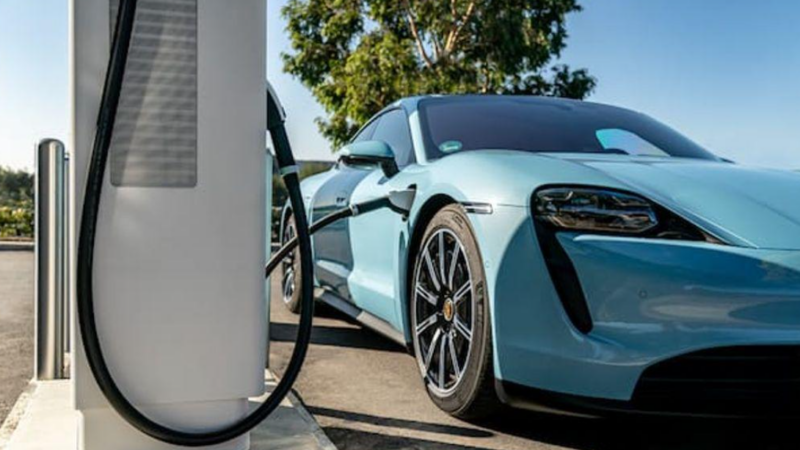
Porsche was an early pioneer of this technology with the introduction of the Taycan. According to Porsche’s official technical information, the updated Taycan supports charging capacities of up to 320 kW at compatible high-performance charging stations.
Actual charging speeds depend on battery temperature, charge level, charging infrastructure and vehicle specifications.
Other manufacturers are also developing advanced high-voltage systems, as demonstrated in CarBook Magazine’s coverage of BMW’s latest fast-charging technology.
Managing Battery Temperatures
Advanced thermal management is essential for achieving consistent charging performance.
Modern electric vehicles can use battery preconditioning technology to bring the battery closer to its ideal charging temperature before arriving at a fast-charging station.
This technology is particularly relevant in the Middle East, where extreme summer temperatures present additional challenges for battery cooling and energy management.
Drivers can learn more about protecting electric vehicle performance through CarBook Magazine’s guide to electric car battery care in the UAE.
What It Means for UAE Motorists
As electric mobility continues to develop across the UAE, high-voltage vehicle platforms could make longer journeys more convenient.
For motorists travelling between Dubai, Abu Dhabi and other emirates, access to compatible fast-charging stations could significantly improve the electric vehicle ownership experience.
Nevertheless, purchasing an 800-volt electric vehicle does not automatically guarantee faster charging at every station. Charging infrastructure must also support the necessary voltage and power output.
CarBook Magazine’s guide to AC and DC charging in the UAE explains these important differences.
The Future of Electric Mobility
As battery chemistry, power electronics and charging infrastructure continue to improve, high-voltage electrical architecture is expected to play an increasingly important role in premium and mainstream electric vehicles.
The objective is clear: less time charging, greater convenience and a more practical electric driving experience.
For the automotive industry, 800-volt technology represents an important step towards making electric mobility more accessible and appealing.