By Fadi Takieddine,
A Legacy Built on Engines
“Aerodynamics are for people who can’t build engines.”
“At Ferrari, we sell engines. The rest of the car is just packaging .”
Those were the immortal words of Enzo Ferrari, repeated whenever journalists pressed him about the details of his cars. To him, Ferrari wasn’t merely a carmaker—it was a creator of masterpieces in combustion. The rest of the machine? Just an elegant frame to carry the beating heart of Maranello: the engine.
Enzo often used such remarks to take playful swipes at his rivals, whom he saw as manufacturers of shells, racing with other people’s engines. And, to be fair, he wasn’t totally wrong.
For decades, Ferrari has built some of the world’s most exhilarating and emotionally charged engines. But that very identity—the soul of Ferrari—is now under threat, as governments around the world, are tightening restrictions on internal combustion engines and accelerating the shift toward electric mobility.
But electric mobility, no matter how quick or clean it is, doesn’t exactly scream “Ferrari”, it simply doesn’t feel like a V12 at full rpm. So the question arises: how will Ferrari adapt without losing its soul?

A Necessary Evil
The truth is, Ferrari began preparing for this transition more than twenty years ago—perhaps without even realizing it.
The company fully understands that electric cars, especially luxury sports cars, lack the visceral appeal of their combustion predecessors. But this isn’t about preference—it’s about survival.
Ferrari didn’t suddenly decide that its howling V8s and V12s were outdated relics. Rather, it recognized a coming reality: one day soon, internal combustion engines might be banned altogether. And when that happens, Ferrari refuses to end up like Nokia or Kodak—great companies with great products that the market left behind.
So, Maranello has chosen what it sees as the lesser evil: build electric cars, or build nothing at all.
Recently, Ferrari even revised its electrification goals, reducing its plan from a 40% fully electric lineup by 2030 to just 20%. That decision speaks volumes. Ferrari will build EVs not out of passion but out of prudence—and for a particular type of customer: those who crave the status and aura of the Prancing Horse, more than its mechanical symphony.
Engineering Emotion
But can an electric Ferrari still stir the soul?
If any company can achieve that, it’s Ferrari. Few automakers have mastered vehicle dynamics quite like Maranello. Its innovations often redefine what performance driving feels like, if not on the time beating performance level, it is surely on the spirited driving level . So when Ferrari introduces its first electric car, it won’t just follow the market—it will set the benchmark.
Just as Ferrari reinvented the thrill of smaller engines with the 296 GTB and F80, it’s expected to compensate for the absence of a combustion soundtrack by fine-tuning the dynamic character of its upcoming EV, using its decades of expertise in chassis control and responsiveness.
This isn’t marketing fluff. Driving pleasure isn’t just about sound—it’s about connection. Since the F430 debuted in 2004, Ferrari has led the charge in blending electronics and mechanics: from its E-Diff (electronic limited-slip differential) and traction/stability systems to later innovations like adaptive dampers, rear-wheel steering, and torque vectoring.
Over the last twenty years, these systems have evolved into a symphony of control—helping novice drivers harness immense power and allowing experts to dance on the edge of physics. Today, nearly every supercar manufacturer follows that same path. Ferrari didn’t just adapt to electronics; it redefined them.

Introducing the Ferrari Elettrica
All that knowledge is now converging in Ferrari’s first electric car, the Elettrica (a working name for now).
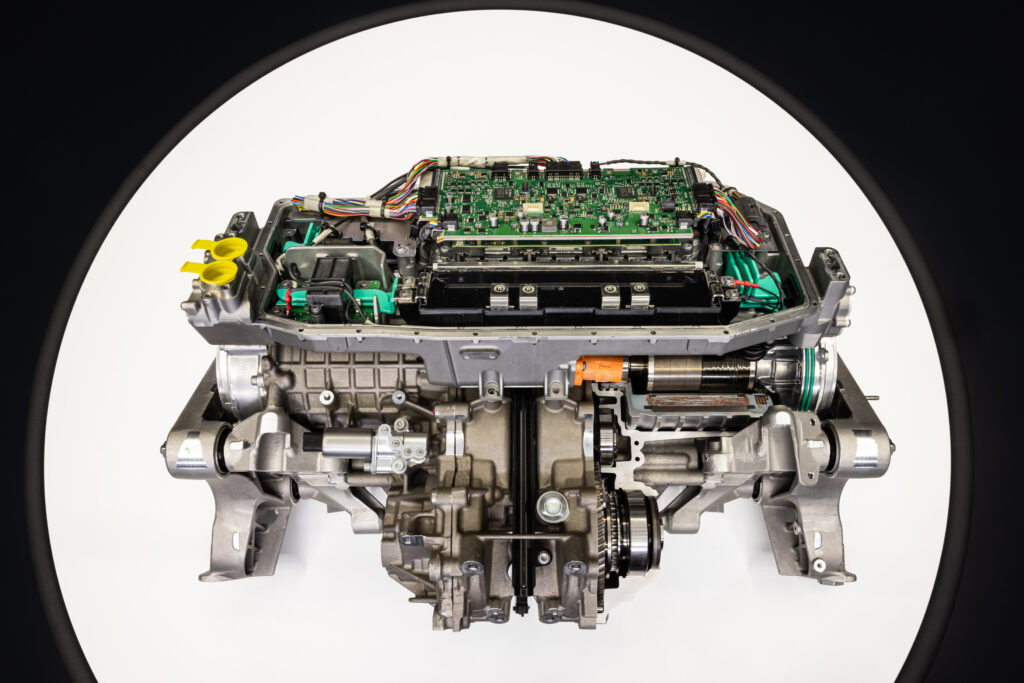
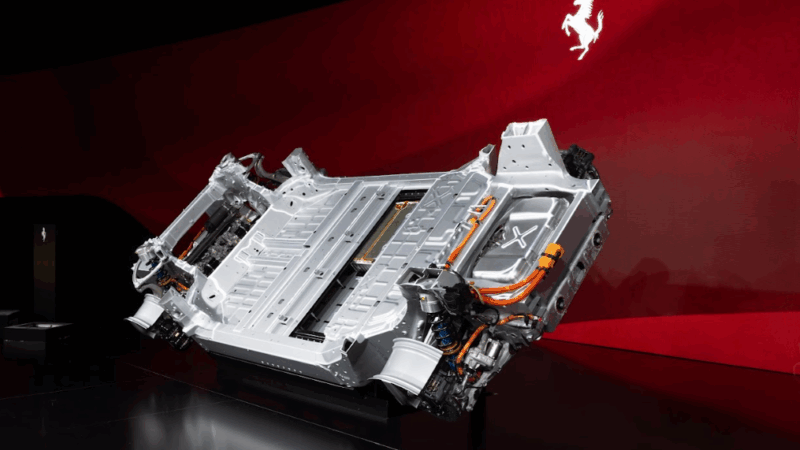
The car will ride on a bespoke 800-volt architecture, with a 122 kWh battery pack and four independent electric motors—one for each wheel. It will feature a 48-volt active suspension, independent rear-wheel steering, and torque vectoring of astonishing precision.
According to Ferrari, the Elettrica will be the company’s first car capable of managing vertical, longitudinal, and lateral forces simultaneously in all driving conditions. In other words, it aims to deliver the same thrill, balance, and control as a traditional Ferrari—but in complete silence.
What truly stands out, however, is the level of integration. The car’s hyper-responsive torque vectoring, active suspension, and rear-steering systems will work together in real time, adjusting the car’s behavior millisecond by millisecond.
Ferrari is also experimenting with new sensory tricks—such as using accelerometers to amplify the electric motor’s sound, and creating five virtual driving modes with varying power and torque, including simulated gear shifts to mimic traditional engagement.
Ferrari may be obliged to build an EV, but it’s determined to make one worthy of the badge on its nose.
The Road Ahead
The global shift toward electrification is happening—but at a slower pace than once predicted. Still, electric cars will inevitably become a major part of the performance landscape. Every manufacturer of high-performance vehicles will need to join the movement sooner or later.
Lamborghini, for instance, may be postponing its first full EV today, but that delay won’t last. When it finally enters the electric arena, it will do so under the shadow—and influence—of Ferrari’s Elettrica, just as it did in the 1960s. In the end, history might indeed repeat itself.