Who Invented the Parking Meter? The 1935 Idea That Changed City Driving
Today, paying to leave a car on a city street feels completely normal. Drivers in Dubai, Abu Dhabi, London, New York and countless other cities now use parking machines, mobile apps and digital payment systems. But less than a century ago, the idea of charging motorists by the hour for a space on the street was revolutionary—and controversial.
The modern parking meter is closely associated with Carl C. Magee, an American lawyer, newspaper editor and civic figure who was trying to solve a growing problem in Oklahoma City: too many cars and too few available parking spaces.
The Parking Problem of the 1930s
By the early 1930s, car ownership in the United States had increased dramatically. Downtown Oklahoma City was particularly congested, and local retailers complained that workers and other motorists were leaving their cars in prime spaces for most of the day.
That meant customers often had nowhere convenient to park.
Magee, who chaired a local traffic committee, began looking for a system that would encourage drivers to move their vehicles after a limited period. His solution was simple but ingenious: put a mechanical timer beside each parking space and make the driver pay according to time.
From an Idea to the Park-O-Meter
Magee did not develop the practical device entirely alone. Engineering expertise from Oklahoma Agricultural and Mechanical College—today Oklahoma State University—helped turn the concept into a functioning meter. Professors Holger G. Thuesen and Gerald A. Hale were involved in developing the working design.
Magee filed a patent application for his coin-controlled parking meter in May 1935. The patent was eventually granted in 1938.
The device became known as the Park-O-Meter.
July 16, 1935: Parking Changes Forever
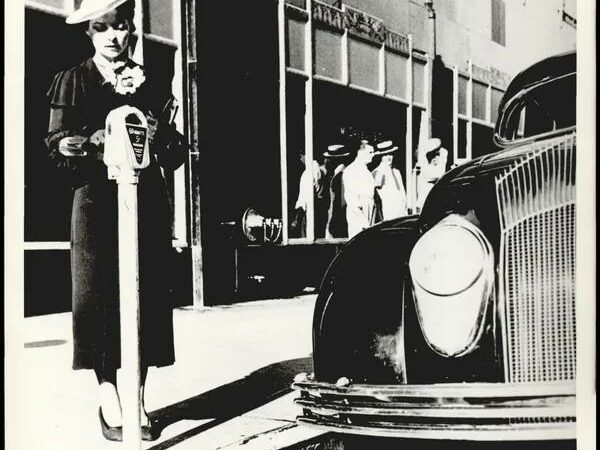
The world’s first modern parking meter was installed in Oklahoma City on July 16, 1935, at First Street and Robinson Avenue.
The price?
Five cents for one hour of parking.
Drivers inserted a nickel and operated the mechanical meter, which measured how much paid parking time remained.
The concept initially faced resistance. Some motorists considered paid street parking unfair and challenged the idea, but merchants appreciated the increased turnover of parking spaces because it allowed more customers to reach downtown businesses.
From Mechanical Meters to Smartphone Apps
The concept spread remarkably quickly. By the early 1940s, more than 140,000 parking meters were operating across the United States.
The technology subsequently evolved from purely mechanical coin-operated meters to electronic machines, credit-card terminals, license-plate recognition and ultimately smartphone-based parking platforms.
The physical meter may eventually disappear from many streets, but Magee’s basic principle remains intact almost 100 years later:
valuable urban parking space is allocated according to time.
That simple concept helped transform how modern cities manage cars—and created something almost every driver now recognizes.