
The Car With No Mechanical Steering Connection
How Mercedes-Benz Is Changing Driving
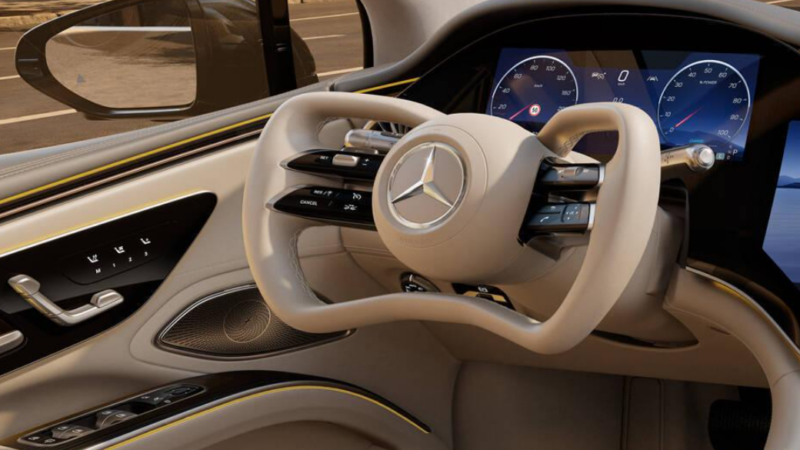
Imagine sitting behind the steering wheel of a luxury car, turning it to navigate a corner, and discovering that there is no mechanical connection between your hands and the front wheels.
It sounds like something from a science-fiction movie.
But Mercedes-Benz has turned this extraordinary idea into reality.
The German automaker has introduced steer-by-wire technology in its EQS electric luxury sedan, replacing the traditional mechanical steering connection with an electronic system.
The development represents one of the most significant changes to the way drivers control automobiles in decades.
And perhaps the most surprising part is that the technology could make everyday driving easier, particularly when parking or navigating tight city streets.
A Steering System That Has Existed for More Than a Century
Since the earliest days of the automobile, drivers have relied on a mechanical connection between the steering wheel and the road wheels.
Over time, manufacturers introduced hydraulic and electric power steering to reduce the effort required to turn the wheel.
But the basic principle remained largely unchanged.
The driver’s movements were transmitted through mechanical components that physically changed the direction of the front wheels.
Steer-by-wire challenges that tradition.
Instead of relying on a continuous mechanical steering linkage, the system uses electronic sensors, computers and actuators to translate the driver’s movements into steering commands.
The result is a fundamentally different relationship between the driver and the vehicle.
How Can a Car Turn Without a Mechanical Connection?
The concept is surprisingly straightforward.
When the driver turns the steering wheel, sensors detect the movement and send electronic signals to a control system.
The system then instructs electric actuators to turn the front wheels.
Because the steering wheel is electronically controlled, engineers can adjust how much steering movement is required in different situations.
At low speeds, such as when parking, the system can respond quickly to relatively small steering inputs.
At higher speeds, it can provide more gradual responses to help maintain stability.
Mercedes-Benz says its new EQS system requires only 170 degrees of steering-wheel rotation from one steering limit to the other.
That means drivers can manoeuvre the vehicle without repeatedly turning a conventional steering wheel through several rotations.
This innovation is part of the broader evolution of software-defined vehicles, where software and electronic controls increasingly shape how cars behave on the road.
The Steering Wheel Itself Looks Different
Removing the conventional mechanical connection also creates opportunities to redesign the steering wheel.
Mercedes-Benz has introduced a flatter, more compact design inspired by modern racing technology.
The unconventional shape improves visibility of the instrument display and creates additional space around the driver’s seat.
It can also make entering and exiting the vehicle easier.
However, changing the steering wheel’s shape introduced another engineering challenge.
Traditional airbags are designed to deploy from the centre of a conventional steering wheel.
Mercedes-Benz therefore developed a new airbag structure specifically adapted to the flattened design.
This required changes to the way the airbag unfolds and maintains its protective shape during a collision.
What initially appears to be a simple design change actually involves considerable engineering.
But What Happens If the Electronics Fail?
This is probably the first question many drivers would ask.
If the steering wheel is no longer mechanically connected to the front wheels, what happens if an electronic component stops working?
Mercedes-Benz has addressed this concern through a redundant safety architecture.
The system incorporates backup signal paths, high-precision sensors and multiple control components.
These are designed to maintain steering functionality if certain components fail.
The manufacturer also says that, in an extremely unlikely complete system failure, rear-wheel steering and individual wheel-braking interventions can help maintain lateral control.
Before introducing the technology, Mercedes-Benz conducted more than one million kilometres of testing across laboratory facilities, proving grounds and public roads.
Nevertheless, steer-by-wire is a significant engineering change, and its long-term reliability will remain an important consideration for consumers.
Why Mercedes-Benz Is Not the First to Try It
Although Mercedes-Benz is the first German manufacturer to offer steer-by-wire in a series-production passenger car, the technology itself is not entirely new.
Other manufacturers, including Infiniti, Lexus and Tesla, have explored or introduced electronic steering systems.
The Tesla Cybertruck, for example, uses steer-by-wire technology to provide variable steering responses.
What makes Mercedes-Benz’s development noteworthy is its integration into a luxury electric sedan designed for everyday road use.
The technology also works alongside rear-axle steering, allowing the vehicle to combine improved manoeuvrability with greater stability.
Mercedes-Benz’s engineering journey has come a long way since the early automobiles pioneered by Carl Benz. Its evolution can also be seen in iconic vehicles such as the Mercedes-Benz 300 SL Gullwing, which introduced distinctive design and engineering solutions of its own.
Could Traditional Steering Wheels Eventually Disappear?
Steer-by-wire opens possibilities that extend beyond easier parking.
Without a fixed mechanical connection, future manufacturers could develop more flexible interior layouts and alternative steering controls.
Engineers could also personalise steering responses according to driving conditions or driver preferences.
The technology may become increasingly relevant as vehicles adopt more sophisticated automated driving systems.
However, conventional steering systems remain highly effective, and the transition to electronic alternatives will depend on safety, cost, reliability and consumer acceptance.
For now, steer-by-wire is still a relatively specialised technology rather than an industry-wide standard.
A Small Change That Could Transform Driving
For more than a century, the steering wheel has been one of the most recognisable components of the automobile.
Drivers have always understood that turning it physically changes the direction of their vehicle.
Mercedes-Benz is now demonstrating that this connection does not necessarily need to be mechanical.
Instead, electronic systems can interpret the driver’s intentions and translate them into precise movements.
The idea might initially feel unfamiliar, particularly to motorists accustomed to traditional steering.
But so did many technologies that eventually became standard equipment.
The next time you turn a steering wheel, consider this remarkable possibility.
In the future, the connection between your hands and the road may be made entirely through electronics.
