The Car With Wings: How a 1954 Mercedes-Benz Became an Immortal Legend
It was born from racing, built with an unusual engineering solution, and became one of the most beautiful automobiles ever created. More than seven decades later, the Mercedes-Benz 300 SL Gullwing continues to capture hearts.
There was a time when opening a car door could stop people in their tracks.
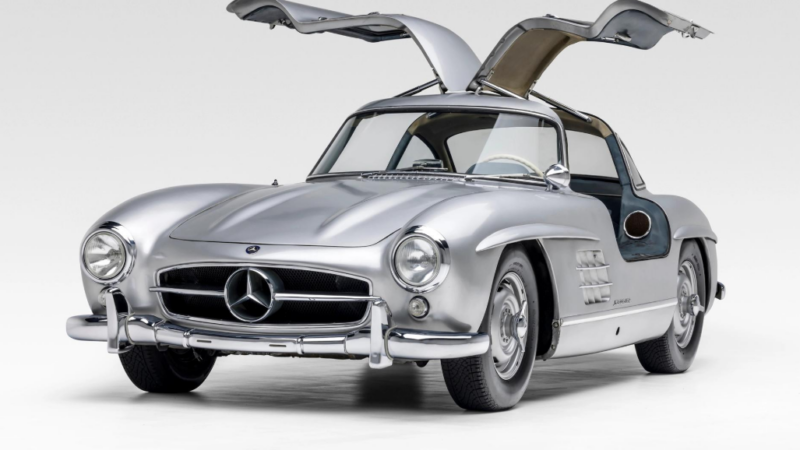
In 1954, visitors attending the International Motor Sports Show in New York witnessed something extraordinary. A sleek silver Mercedes-Benz stood before them, but instead of conventional doors, two enormous panels rose towards the sky like the wings of a bird.
The car was the Mercedes-Benz 300 SL Gullwing.
Nobody standing around that remarkable machine could have known just how enduring its legend would become.
A Beautiful Accident of Engineering
Surprisingly, the Gullwing’s most famous feature was never originally intended as a fashion statement.
The 300 SL evolved from Mercedes-Benz’s successful 1952 racing car. Engineers had developed a lightweight tubular space frame to provide exceptional structural rigidity.
There was just one problem.
The frame’s unusually high sides made conventional doors impractical.
Rather than compromise the car’s construction, engineers created doors hinged to the roof. When opened, they resembled the wings of a seagull.
An engineering necessity had accidentally produced one of automotive history’s most recognisable designs.
The original racing 300 SL had already achieved remarkable victories, including success at Le Mans in 1952.
Encouraged by American importer Max Hoffman, Mercedes-Benz transformed its racing achievement into an extraordinary road-going sports car.
The production 300 SL introduced advanced technology, including direct petrol injection for its six-cylinder engine, while combining impressive performance with elegant styling.
Yet its greatest achievement was emotional.
The Gullwing was more than transportation. It represented freedom, ambition and the possibility of owning something genuinely extraordinary.
As explored in CarBook Magazine’s Why Classic Cars Continue to Capture Hearts Around the World, the appeal of historic automobiles often extends far beyond horsepower and performance figures.
When an Old Car Becomes a Treasure
Only 1,400 Gullwing coupés were produced between 1954 and 1957.
Their rarity, craftsmanship and historical significance have made surviving examples highly desirable among collectors.
But what makes this Mercedes-Benz truly special is not simply its potential monetary value.
It is the experience of approaching the car, lifting those extraordinary doors and entering a cabin that belongs to another era.
The sound of its engine, the mechanical feel of its controls and the elegance of its proportions create an experience that modern technology cannot entirely reproduce.
This fascination with preservation is also reflected in CarBook’s Preserving Automotive Legends, which explores why collectors dedicate years to protecting historic vehicles.
A Legend That Refuses to Grow Old
Today, the automotive world is rapidly embracing electrification, digital technology and autonomous driving.
Yet the Gullwing continues to attract attention wherever it appears.
It reminds enthusiasts that a truly remarkable automobile can transcend generations, trends and technological change.
CarBook Magazine’s feature on Why Modern Cars Feel Less Exciting explores the emotional connection that traditional driving experiences can create.
The Mercedes-Benz 300 SL embodies that connection.
Seventy-two years after its debut, its doors still rise towards the sky, its design remains unforgettable, and its story continues to inspire.
Because some cars are built to travel.
Others are built to be remembered.
Historical facts verified against Mercedes-Benz’s official archives.