When Was the First Car Invented?
The 1886 Benz Patent-Motorwagen Changed Transportation Forever
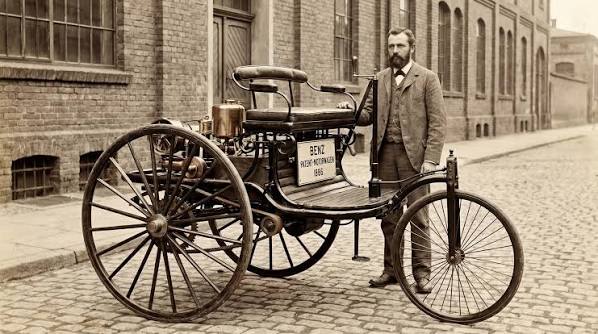
Today’s cars feature electric motors, advanced safety systems and intelligent technology, but the story of the automobile began with a surprisingly simple three-wheeled machine. Widely recognised as the world’s first practical petrol-powered automobile, the Benz Patent-Motorwagen was created by German engineer Carl Benz in Mannheim, Germany.
Carl Benz developed the vehicle in 1885 and applied for a patent on January 29, 1886. German Patent No. 37435 described it as a “vehicle powered by a gas engine,” and the document is often considered the birth certificate of the modern automobile.
Unlike earlier experimental vehicles, the Patent-Motorwagen was not simply a traditional horse-drawn carriage fitted with an engine. Benz designed its engine, chassis and drivetrain together as one complete machine. This approach established the basic idea behind the modern automobile.
The vehicle had three wheels: two large wheels at the rear and one smaller wheel at the front. Benz selected this configuration because reliable steering for a four-wheeled vehicle had not yet been perfected.
At the heart of the Patent-Motorwagen was a single-cylinder, four-stroke petrol engine mounted at the rear. It produced less than one horsepower, a tiny figure compared with even the smallest modern cars. Nevertheless, it was powerful enough to move the lightweight vehicle at approximately 16 kilometres per hour.
The car also featured several technologies that would become essential to future automobiles, including electric ignition, evaporative cooling, a differential, steel-spoked wheels and a belt-driven transmission.
Bertha Benz Proved the Car Could Change the World
Carl Benz’s invention initially attracted curiosity and scepticism. Many people could not understand why anyone needed a noisy motor vehicle when horses already provided reliable transportation.
The turning point came in August 1888, when Carl’s wife, Bertha Benz, took an improved version of the car on the world’s first long-distance automobile journey. Without informing her husband beforehand, Bertha travelled with her two sons from Mannheim to Pforzheim.
The journey demonstrated that the automobile could travel beyond short experimental runs. Bertha solved several mechanical problems along the route and even stopped at a pharmacy to purchase ligroin, the fuel used by the vehicle. That pharmacy is sometimes described as the world’s first filling station.
Her pioneering drive proved the practical value of the invention and helped attract public attention to the Benz automobile.
Steam-powered road vehicles had existed before the Patent-Motorwagen. In 1769, French inventor Nicolas-Joseph Cugnot constructed a steam-driven vehicle. However, Carl Benz’s creation is generally recognised as the first automobile designed from the beginning around an internal-combustion petrol engine.
From this three-wheeled machine came an industry that transformed cities, travel and international commerce. Nearly 140 years later, the automobile continues to evolve through electrification, autonomous technology and digital connectivity.
Discover more automotive history, innovation and industry developments in CarBook News and explore the latest automotive technology in CarBook Features.