When Was the First Traffic Light Invented?
The 1868 London Invention That Changed the Way the World Moves
Long before smart intersections, LED signals and connected cars, the world’s streets faced a much more basic problem: how to control traffic safely.
Long before smart intersections, LED signals and connected cars, the world’s streets faced a much more basic problem: how to control traffic safely.
Surprisingly, the first traffic light appeared before the modern automobile was even invented.
The story began in London in 1868, when horse-drawn carriages, pedestrians and other road users crowded the streets around the Houses of Parliament. Growing congestion created a need for a more organised way to control movement through busy junctions.
For more stories about inventions and vehicles that shaped transportation, explore CarBook Magazine’s Heritage section.
The World’s First Traffic Signal
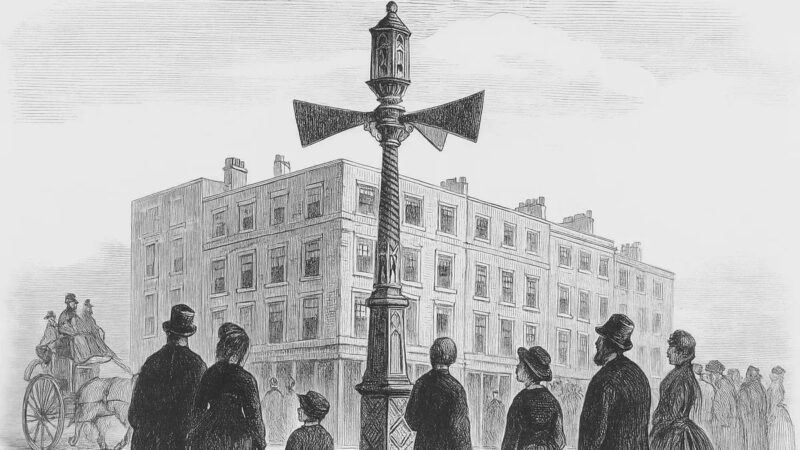
On 9 December 1868, a traffic signal designed by British railway engineer John Peake Knight was installed near the Houses of Parliament in Westminster.
Knight borrowed the concept from railway signalling. Instead of today’s familiar electric red, amber and green lights, the system used semaphore-style arms during daylight and red and green gas-powered lamps at night.
A police officer had to operate it manually.
The experiment was innovative but short-lived. A gas leak caused an explosion in January 1869, injuring the police officer operating the device.
Despite its brief life, Knight’s invention established an important concept: road traffic could be controlled using visual signals.
The Electric Traffic Light Arrives
As automobiles became increasingly common during the early 20th century, cities needed a safer and more efficient system.
One major breakthrough came in Cleveland, Ohio, in 1914, where an electric traffic signal designed by James Hoge was installed at East 105th Street and Euclid Avenue.
The system used red and green signals together with the commands “stop” and “move.”
You can read more about the development of Cleveland’s early electric traffic signals through the Cleveland Police Museum.
Electricity made traffic signals far more practical and helped pave the way for the automated systems used around the world today.
You May Also Like: Follow the latest launches, automotive technology and mobility developments in CarBook Magazine News.
Garrett Morgan Makes Traffic Safer
Another important figure in traffic-light history was American inventor Garrett A. Morgan.
After witnessing a collision between an automobile and a horse-drawn carriage, Morgan began developing a safer traffic-control system.
His design introduced a third position that temporarily stopped traffic in all directions before another stream of vehicles was allowed to move.
Morgan received a U.S. patent for his traffic signal on 20 November 1923.
The U.S. Federal Highway Administration describes Morgan’s invention as an important contribution to the development of modern traffic management and road safety.
His three-position system addressed one of the biggest weaknesses of earlier stop-and-go signals: drivers had little warning before traffic flow changed.
The principle eventually evolved into the familiar transition stage represented by the modern yellow or amber light.
From Gas Lamps to Intelligent Intersections
More than 150 years after London’s first experiment, traffic-light technology has changed dramatically.
Modern systems can now incorporate vehicle sensors, cameras, pedestrian controls, intelligent timing systems and traffic-management software.
Some cities are also experimenting with connected infrastructure capable of communicating directly with vehicles.
These developments form part of the wider transformation of mobility explored regularly in CarBook Magazine Features.
Yet the basic purpose remains remarkably similar to what John Peake Knight attempted to achieve in 1868: bring order to the road and allow people to move more safely.
From a manually operated gas lamp in Victorian London to today’s intelligent intersections, the traffic light is a reminder that even the most familiar pieces of road infrastructure have fascinating stories behind them.
Read Next: Discover more automotive history, classic cars and inventions that changed mobility in CarBook Heritage.